21 October 2025
The secrets to recognize quality leather shoes
Kabundji Editorial · 6 min read
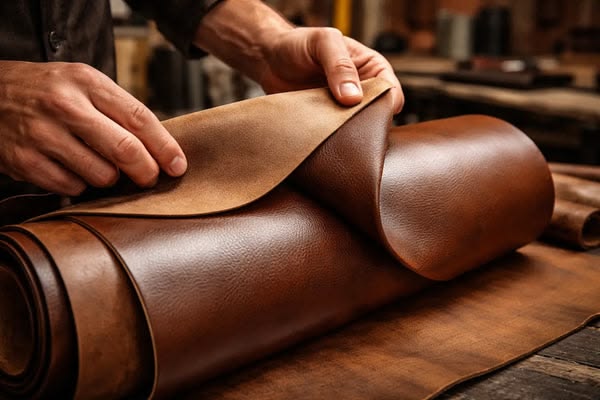
A well-made shoe announces itself in ten seconds. An expensive shoe sometimes doesn't. Here's how to tell the two apart.
In person
Smell. Real full-grain leather smells faintly of tannery — sweet, earthy, slightly animal. Corrected-grain and bonded leather smell of plastic or solvent. Open the tongue and sniff the lining. Lining is where cheaper leather hides.
Bend. Flex the shoe. Good calf bends without the surface fracturing; bad leather spiderwebs instantly. The sole should bend too, but recoiled — not stiff like cardboard, not floppy like rubber.
Look at the welt. The welt is the strip between the upper and the sole, stitched on both sides. If you see two lines of stitching (one going into the upper, one going into the sole), the shoe is Goodyear-welted — repairable for life. If you see glue, it's cemented. Glued shoes are not disposable, but they are not lifetime.
Look at the heel stack. A leather heel should show layered leather edges. If it looks monolithic, it's a single moulded piece and will collapse earlier.
Online
Zoom on the heel seam. Should be a single vertical line, invisible or nearly so, with no visible folds.
Check the toe cap curve. On a proper last, the cap-toe line is a clean curve. If it's slightly wobbly, the pattern isn't precise. Cheap labels hide this with darker dyes.
Read the construction spec. Words like Goodyear welted, Blake stitched, Norwegian welt tell you the shoe can be resoled. Cemented, vulcanised, or no mention at all means it can't.
Leather origin. French, Italian, German, or Spanish tanneries do good work (Du Puy, Annonay, Zonta, Horween, Ilcea). A shoe that names its tannery is usually a shoe worth trusting.
Price sanity check
Under €250 new: almost never full-grain + welted. You're paying for marketing.
€250–500: possible to find a real welted shoe from younger European brands. Watch for corners cut on the last or lining.
€500–1000: the honest middle. Most self-respecting shoemakers live here.
Over €1000: real craft, bespoke-adjacent, or marked-up branding. Check why it's priced there — provenance should justify it.
The 30-second checklist
- Full-grain, not corrected-grain or bonded.
- Welted construction, visible stitching both sides.
- Leather lining, not synthetic.
- Leather sole — or a good Dainite/Vibram commando for weather.
- Heel stacked in layers.
- Clean symmetric pattern, matched grain on both shoes.
- A shoe tree and dust bag in the box is a nice sign, not a guarantee.
Seven items. Under a minute. It will save you many euros.